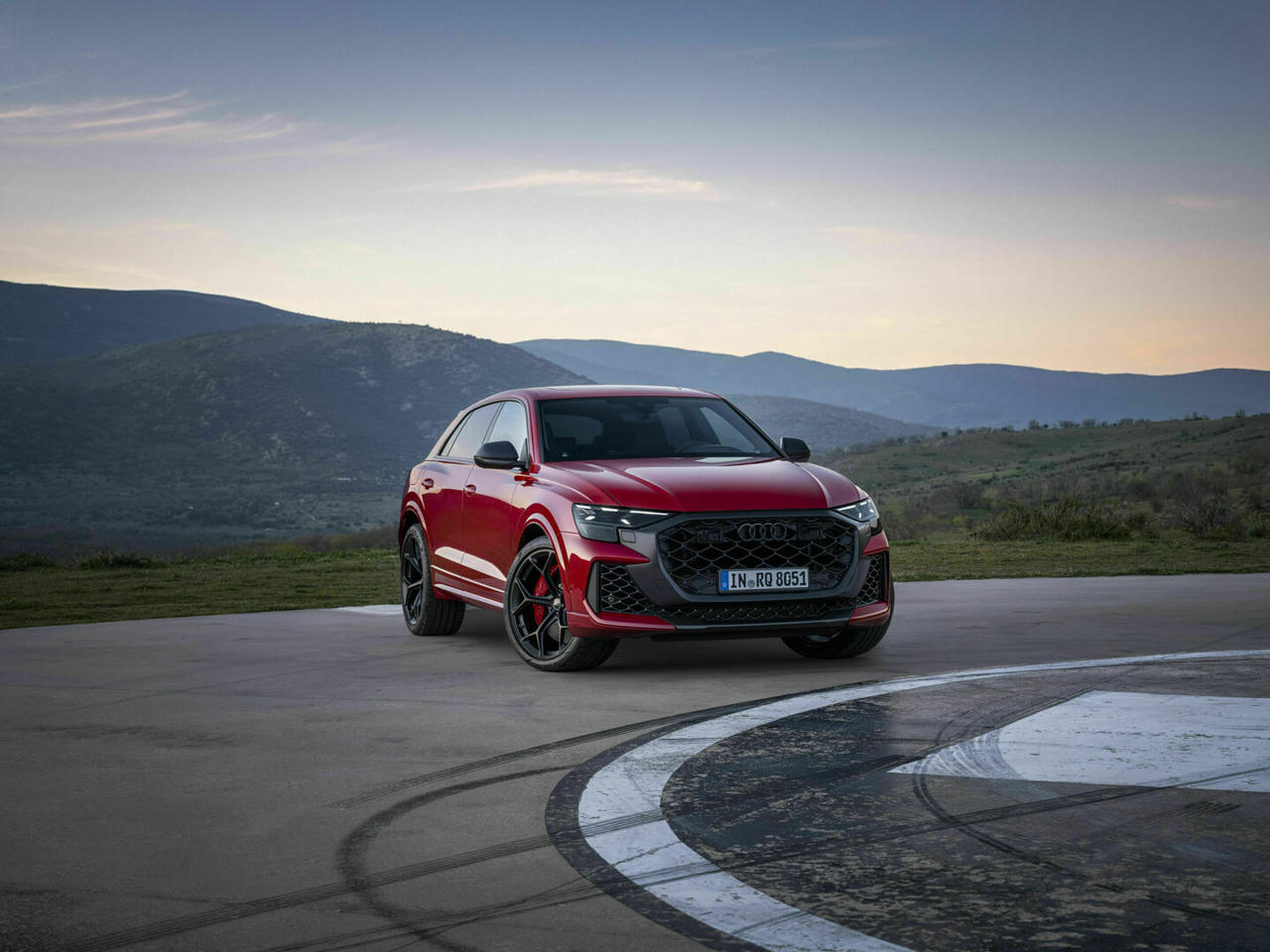
Inspired by motorsport
The new Audi RS 5 represents another first for the coveted RS ranks.
The famed Audi Sport RS designation always guarantees something very special, and the new RS 5 models, arriving here before year’s end, promise to deliver not only next level performance but a new era of RS.
27 August, 2026
The expectation has been building all year, since the all-new RS 5 made its first local appearance back in March at Audi’s Trackside suite at the Australian Grand Prix. Although put through its paces for a video shot at Melbourne’s Albert Park Grand Prix circuit, the RS 5’s appearance was otherwise a static affair, with only the professional drivers involved in filming able to get a sense of the all-new hybrid drivetrain that is set to elevate the RS experience.
The RS 5, which will touch down in Australia in both Sedan and Avant body styles represents a number of firsts for Audi Sport. The first RS to come from the new naming designation that saw the union of the A5 and A4 models, most importantly it introduces high-performance hybrid drive to the highly specialised Audi Sport models for the first time. While all-electric power made its debut in the RS ranks with the RS e-tron GT, bringing that instantaneous electric thrust together with the power of a high-performance combustion engine is a significant milestone that results in extraordinary performance characteristics. Effectively the best of both worlds.
That pairing of a 3.0-litre twin-turbo V6 with a powerful electric motor produces a system output of 470kW and 825Nm of torque – an increase over the previous model of 139kW and 225Nm of torque.
That’s enough to rocket the RS 5 from a standstill to 100km/h in 3.6 seconds on the way to its ‘standard’ top speed of 250km/h or 285km/h when fitted with the optional Audi Sport package.
But the new RS 5 is also capable of quietly tooling around town utilising its electric motor only, with the Sedan offering up to 78 kilometres of purely electric drive and the slightly larger Avant variant delivering 76 kilometres.
Built using the brand’s Premium Platform Combustion (PPC), the RS 5 is the result of a cross-site development architecture that has been established over many years. The engine development team in Neckarsulm and Audi Hungary in Győr work hand in hand to produce the new model – from conception through pre-production to continuous engineering.
In order to increase the responsiveness and performance of the 3.0-litre, twin-turbo V6 engine, Audi’s engineer’s designed the shortest and least restrictive intake system possible from the ground up. Water-to-air intercoolers are used for the first time in the RS 5, lowering intake temperatures – especially under intense conditions. This makes for a more powerful and efficient engine than before, which, when mated with the 130kW electric motor makes for almost instantaneous throttle response, as well as looking after duties such as starting the engine and doing away with the need for a 12-volt starter motor.
The design and validation of the powertrain was the responsibility of the engine development team in Neckarsulm and then following the successful completion of the pre-production phase, Audi Hungary in Győr takes over continuous engineering and manufacturing.
“Developing a high-performance vehicle like the RS 5 is only possible with clearly structured processes and well co-ordinated workflows,” says Sascha Srebacic, Head of Engine Mechanics at the Audi site in Neckarsulm.
The brand’s expertise in hybrid drives used in motorsport from Le Mans to Dakar are well documented and have now been further developed for use in a high-performance hybrid drive for the road. It’s a process that brought together the cream of the brand’s engineering, design and motorsport experts, drawing on its vast experience across disparate technologies to create the perfect blend for the next generation Audi RS models.
“Co-operation throughout all phases of development, from the initial concept to series production, is a key factor in the success of the RS 5,” says Richard Majer, project co-ordinator in Technical Development at Audi Hungary in Győr.
The electric motor and the 400-volt electrical system are powered by a newly developed 25.9 kWh battery (22kWh net) that is situated under the floor of the boot. New cell chemistry means that the battery is able to output more power at low states of charge as well as in extreme temperatures, and as well as powering the motor, it also sends up to 8kW to the permanent-magnet synchronous motor in the torque vectoring unit.
Charging is supported via a 11kW AC system, which means it can be fully charged in around two and half hours, and the advanced management systems means that the high state of charge needed for the RS 5’s performance modes is maintained whenever the RS sport and RS torque rear modes are activated.
That means to ensure full electric support is available – for example for torque vectoring – the vehicle holds the state of charge at a high 90 percent in the modes RS sport and RS torque rear to ensure drivers always have access to maximum electric power when ‘things get serious’.
In addition to the use of a high-performance plug-in hybrid drive for the first time, the RS 5 also sees the debut of a new generation centre diff to handle torque distribution between the front and rear axles. It features preload, which means that it is always at least partially locked, and forms the newest and highest level of quattro drivetrains.
Indeed when it comes to the drive concept of the Audi RS 5, the entire package is entirely new. It combines the centre diff with preload and innovative electro mechanical torque vectoring at the rear. Here a water-cooled permanent-magnet electric motor with an output of 8kW and 40Nm serves as a high-voltage actuator, overdrive gears, and a conventional differential with low lock percentage as the key components.
Combined, they distribute torque between the rear wheels, and they do it fast. In fact it takes just 15 milliseconds – around a 10th of the time it takes to blink – for the electro mechanical torque vectoring to deploy torque differences of up to 2000 newton metres and react to any driving situation.
To take full advantage of the extraordinary power as well as optimally handling the longitudinal and lateral forces, the rear axle was redesigned from scratch and the RS 5 uses five-link suspension front and rear which has undergone significant work. This includes the use of twin-valve dampers which allow for both compression and rebound to be controlled independently. The result in something of a dual personality that allows for a comfortable ride when touring, or letting the driver take advantage of the car’s full performance when circumstances allow.
Of course all this requires an equally serious braking system which comes in the form of 20-inch RS steel brakes, with 420mm discs up front and 400mm on the rear with a choice of black or red calipers. There is also a 21-inch RS ceramic option available with 440mm dice front and 410mm rear, in a system which weighs some 30kg less than their steel counterparts. And, in another segment-first, ceramic disks are also fitted at the rear, which allows the RS 5 to stop in 30.6 metres from 100km/h.
Every aspect of the RS 5’s ‘under skin’ development has been geared around performance and delivering the most exciting package and that of course extends to the car’s appearance, whether it be in Sedan or Avant body style.
The design of the RS 5 has been significantly influenced by motorsport according to Audi exterior designer Wolf Seeber.
“For us as designers it’s really a dream to work on a car like the RS 5 because the base car is already super attractive,” says Seeber.
“With the RS we are able to enhance the proportions. We have a better stance, we have a wider track … everything is linked to motorsport and the details are clearly there to perform.”
Airflow to the combustion engine and for the braking system has been significantly improved through the larger Singleframe grille and front intakes. Massive guards swell to allow for the 20 or 21-inch Audi Sport allow rims through which the brakes are clearly visible and even the daytime running light signatures feature a cheeky nod to motorsport with their checkered flag design. The result is an unmistakably performance oriented car – very much a wolf in wolf’s clothing.
So, while many of the RS 5’s attributes are very familiar to RS aficionados, in the true spirit of the brand’s Rennsport models, it continues to push the limits and to redefine what automotive performance means now and into the future.
The new Audi RS 5 models are due to arrive in Australia before the end of the year, with the RS 5 Sedan starting from $179,900* the Audi RS 5 Avant from $182,900*. For more information or to register your interest, visit audi.com.au
Subscribe
Want to ensure you always receive the latest news and features from Audi? Subscribe now to the Audi Magazine newsletter.
Audi Australia will collect, record and use your personal information for the purpose(s) of sending you the requested newsletter. You are not required to provide your personal information, however, if you choose not to provide us with your personal information, we may not be able to fulfil the purpose(s) described above. We will keep your personal information for only as long as is necessary to carry out the purpose(s) described above (unless we are required or permitted by law to hold the information for a longer period). We may disclose your personal information to our service providers and to our dealership network in Australia. We may also disclose your personal information to our related parties based in Australia and to our overseas service providers. We may, unless you have opted out, use your personal information to market our products and services to you, to improve our products and services and to invite you to events. We will act in accordance with our privacy policy which is available at http://www.audi.com.au/privacypolicy. If you would like to know more about our privacy policy and procedures and the management of your personal information, or if you would like to access or update your personal information, please contact our customer assistance team, T +1800 50 AUDI (2834), E customerassistance@audi-info.com.au