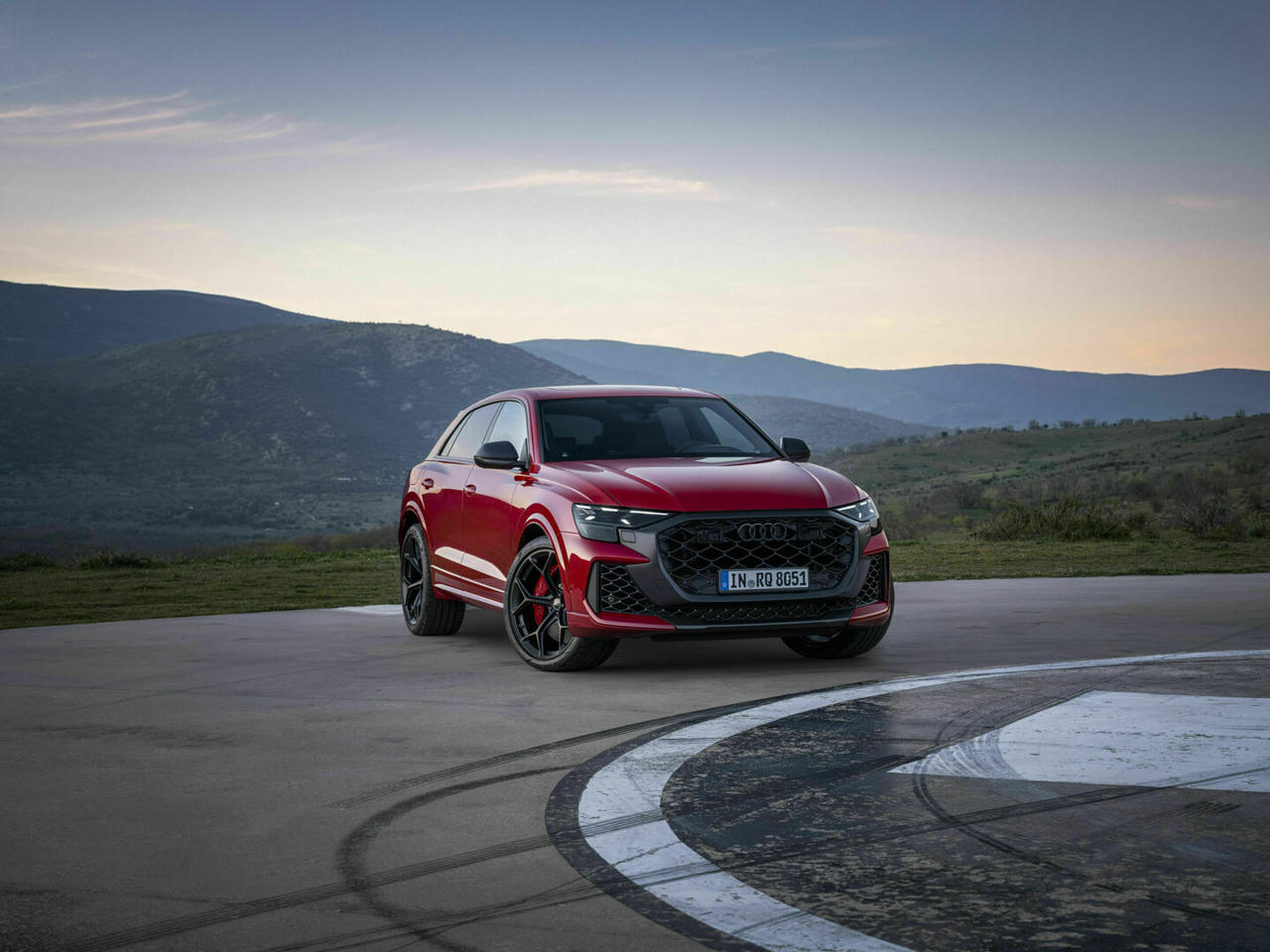
Statement of intent
Behold the Audi Nuvolari, the fastest and most powerful production model in the brand’s history.
The limited edition Audi Nuvolari is Audi’s first supercar using a high-performance hybrid powertrain – but it is also a very serious statement of intent.
5 June, 2026
No, this is not a design study or another concept car, but a striking, limited run production vehicle. The first model to feature the brand’s new design direction first revealed with the Concept C, the Audi Nuvolari is a strictly limited edition production reality that is also the fastest, most powerful production model in the brand’s history.
It features a high-performance hybrid powertrain that generates 736kW and hits 100km/h in just 2.6 seconds from standstill. It also showcases the world-first quattro predictive ride as well as active aerodynamics derived from Formula 1 and the new Audi Space Frame (ASF) with carbon exterior. All this in a striking new design both inside and out that is cutting-edge, yet incorporating elements from the brand’s history.
Named after Tazio Nuvolari, the legendary driver of the 1930s, the Audi Nuvolari represents a milestone moment for Audi. New design, new technology and a new, very exciting direction for the future.
“In times of fundamental change, we are making bold strategic decisions,” says CEO Gernot Döllner.
“The Audi Nuvolari brings pure emotion and performance to the road. It also reveals how we are taking ‘Vorsprung durch Technik’ into a new era.
“With the Audi Nuvolari, we are accelerating technological progress … it shows what is possible when the focus is on technology, performance, and execution through teamwork — and when we achieve progress together.”
Just 499 units of the Nuvolari will be made, with first deliveries going to customers from early next year. For those fortunate enough to own a piece of Automotive and Audi history, the car represents a technological and design milestone, drawing heavily on Audi’s involvement in Formula 1. From the Titanium exterior colour used on both the Concept C and the Audi Revolut F1 Team R26 race cars, to the lightweight construction, Audi Space Frame technology with a carbon exterior, it represents the very cutting-edge of design, engineering, technological innovation and performance.
The man whose team is behind the new design language, Chief Creative Officer Massimo Frascella, says that the Nuvolari is the embodiment of Vorsprung durch Technik ‘in its most visceral form’ executed using the very latest techniques and technology to create a cohesive whole.
All carbon fibre components for example have been developed with the use of Formula 1 expertise, with carbon fibre reinforced polymer (CFRP) used for almost all of the car’s exterior, while in areas exposed to high temperatures, specifically tuned heat-resistant materials are employed that combine functional performance with distinctive visual accents.
Aero too comes straight from Formula 1, with a system that adjusts downforce, drag and aerodynamic balance in response to driving conditions. Indeed Audi’s Formula 1 drivers provided targeted feedback during the development phase for a result that sees every component and surface serving a specific purpose.
Front air intakes ensure effective brake cooling as well as efficient thermal management of the combustion engine and hybrid components, while a vented front end, known as an S‑duct, improves aerodynamic efficiency at the front axle – delivering additional downforce, reducing lift at high speeds and improving cooling of the powertrain.
Then there is the deployable adaptive rear wing which controls downforce and drag across three settings – Closed, Low Downforce (LD), and High Downforce (HD). In this high-downforce configuration, the car’s aero package can deliver more than 400kg of downforce and the rear wing position can be controlled both automatically and manually via a rotary control on the steering wheel – in all driving modes except E‑Hybrid. Every detail has been considered and refined in the package right down to the solid-metal Audi rings integrated flush into the deployable rear wing to ensure optimal performance.
And what performance there is! With its hybrid powertrain outputting 736kW, it combines a 4.0-litre biturbo V8 combustion engine good for 588kW with three axial flux electric motors, each producing 110kW. The V8 engine alone delivers a maximum torque of 730Nm and reaches up to 10,000rpm, which was previously not possible outside motorsports.
Two of the oil-cooled axial flux electric motors are located on the front axle and deliver up to 2150Nm, while the third motor sits between the V8 and the transmission. The lithium-ion battery employed has a gross capacity of 7.3 kWh.
In the real world this all translates to 0 to 100km/h in 2.6 seconds and from 0 to 200km/h in 6.8 seconds with a top speed in excess of 350km/h.
The Nuvolari also presents the next generation of Audi quattro, with a system that uses data on steering angle, acceleration, yaw rate and grip levels to continuously update and adjust the system. That means if it anticipates a potential loss of grip in a corner, it responds proactively, adjusting torque distribution precisely in both longitudinal and lateral directions, while the brakes stabilise the vehicle with targeted interventions and the aerodynamics adjust downforce according to the situation.
The electric motors at the front axle allow variable torque vectoring and the intelligent and predictive tuning of vehicle dynamics ensures maximum traction and control, no matter the conditions. Drivers can also adjust the system using controls on the steering wheel, choosing between the likes of E-hybrid mode for fully electric driving, to a mix for comfort. Then there are the dynamic settings, with Dynamic dialling everything up for greater agility and responsiveness through to Dynamic+ which focuses the powertrain entirely on an emotional driving experience.
Given the massive power on tap, there is of course a Track mode which allows the adjustment of traction control to suit say, wet conditions or even Traction Control Off for race scenarios.
Braking is more than up to the incredible power of the Nuvolari with precise interaction between hydraulic braking and electric deceleration. Again drawing on motorsport, a brake-by-wire system enables variable distribution between recuperation and hydraulic braking.
At the front axle, 10-piston fixed calipers work with 420 × 40mm brake discs, while at the rear, four-piston calipers are paired with 410 × 32mm discs, using brake discs derived directly from Formula 1. There is also a specially designed internal cooling system for the brake discs, which improves airflow and increases heat dissipation by up to 21 percent compared with conventional carbon-ceramic systems. This means that the braking system is able to handle extreme deceleration loads of up to 2.8 megawatts which put it on par with a current Formula 1 car.
Of course when this level of stopping power is not required, purely electric deceleration of up to 0.3 g is possible, which is of course the norm in the bulk of daily driving. This allows for additional energy recuperation, working with the car’s adaptive strategies that includes coasting and brake recuperation to extend energy recovery. In an energy management system that is also inspired by motorsport, boost and recuperation strategies are closely linked to torque distribution and as an integrated system, it continuously manages the interaction between power delivery and energy recovery – adapted to driving conditions, grip level and driver intent.
The integrated architecture of power delivery, torque distribution, and energy recovery becomes especially evident in the Launch Control function. Here, the system makes targeted use of stored energy for maximum acceleration – another concept derived directly from Formula 1.
So, a supercar and a race car, as well as a design masterpiece and a clear statement of intent from Audi as to the future direction of the brand. The Nuvolari is all of these things and more. Aptly named after Tazio Nuvolari whose skill on the track in the 1930s was matched only by his extraordinary bravery, pushing the cars he drove to the very limits – it is a car that likewise pushes the limits.
The fortunate 500 (well 499 to be precise) who take delivery of this extraordinary car are certainly in for an automotive treat. But the very existence and production of the Nuvolari promises all manner of surprises for future Audi models and given the lightening turnaround of the project, those could well be closer than anyone thinks.
Subscribe
Want to ensure you always receive the latest news and features from Audi? Subscribe now to the Audi Magazine newsletter.
Audi Australia will collect, record and use your personal information for the purpose(s) of sending you the requested newsletter. You are not required to provide your personal information, however, if you choose not to provide us with your personal information, we may not be able to fulfil the purpose(s) described above. We will keep your personal information for only as long as is necessary to carry out the purpose(s) described above (unless we are required or permitted by law to hold the information for a longer period). We may disclose your personal information to our service providers and to our dealership network in Australia. We may also disclose your personal information to our related parties based in Australia and to our overseas service providers. We may, unless you have opted out, use your personal information to market our products and services to you, to improve our products and services and to invite you to events. We will act in accordance with our privacy policy which is available at http://www.audi.com.au/privacypolicy. If you would like to know more about our privacy policy and procedures and the management of your personal information, or if you would like to access or update your personal information, please contact our customer assistance team, T +1800 50 AUDI (2834), E customerassistance@audi-info.com.au